Reading the Sticker Like a Pharmacist: Making Sense of Auxiliary Labels on Canadian Prescriptions
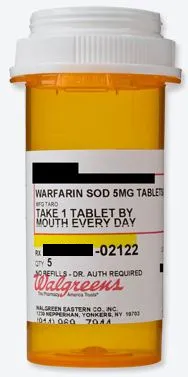
Photo: JCRules, CC BY-SA 3.0, via Wikimedia Commons
A Canadian prescription bottle often carries more than a dosing direction. It may have a small sticker warning that the medication can cause drowsiness, a symbol advising patients to take it with food, or a line telling them to avoid alcohol. These auxiliary labels are familiar, but familiarity can lead patients to skim them. The result can be a medication taken correctly by the clock and incorrectly for the circumstances.
More than decoration: what auxiliary labels are for
Auxiliary labels are supplementary warnings and instructions. They do not replace the prescriber's directions or the pharmacist's counselling, and they are not a complete medication guide. Their purpose is to flag the most important practical issues: food, alcohol, alertness, crushing or splitting, storage, and finishing a course of treatment. Because they are brief, they can oversimplify. A sticker that says take with food does not explain what counts as food, and a sticker that says may cause drowsiness does not say whether the effect is likely to be mild or significant for a particular patient.
That is why the label should be read as a prompt for a conversation, not as a substitute for one. In Canada, pharmacy practice varies by province, but the principle is consistent: the pharmacist is responsible for providing clear directions and for answering questions about how a medication should be used.
Common stickers and what they mean in real life
Take with food
This usually means taking the medication with a meal or snack to reduce stomach upset or improve absorption. It does not necessarily mean a full three-course meal. For a medication taken once daily, breakfast may be the easiest anchor. For a medication taken twice daily, breakfast and dinner may work. If a patient skips a meal, the correct response depends on the drug. Ask the pharmacist whether the medication can be taken with a light snack or whether a missed food pairing should mean a missed dose.
Avoid alcohol
This warning appears for reasons that range from increased drowsiness to changes in how a drug is processed. It is not a universal rule for every antibiotic or pain reliever, and it is not a challenge to see how little alcohol can be consumed. If a patient is planning a celebration, a holiday dinner, or a glass of wine with a meal, the safer approach is to ask the pharmacist about that specific medication rather than rely on a general impression.
May cause drowsiness
This is one of the most consequential stickers for daily life. It matters for driving, operating machinery, cycling, and caring for dependants. It also matters when the medication is combined with alcohol, cannabis, or other sedating drugs. A patient who feels alert after the first dose should not assume that the effect will be the same after a dose increase or a missed night of sleep. Ask whether it is safe to drive and whether the medication is better taken at bedtime.
Take on an empty stomach
Empty-stomach instructions are often more precise than they appear. Some medications should be taken one hour before a meal or two hours after one. Others are less strict. A patient who takes the medication with coffee and toast may be undermining the intended effect without realizing it. The pharmacist can translate the instruction into a practical timetable.
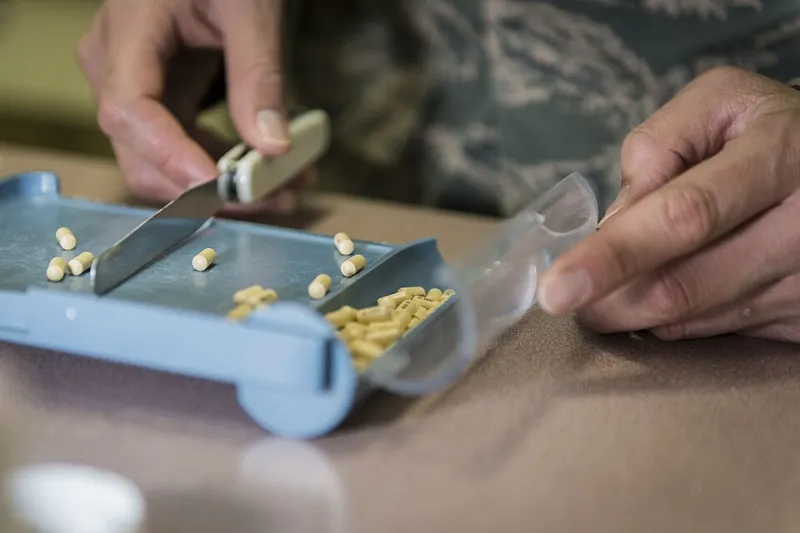
Do not crush or split
This sticker protects special dosage forms such as extended-release tablets or enteric-coated products. Crushing them can release the drug too quickly or defeat a coating designed to protect the stomach. If swallowing is difficult, do not improvise. Ask the pharmacist whether a liquid, a different strength, or another formulation is available.
Finish all medication
This is common for antibiotics and some other courses. It is not a suggestion to save leftover medication for later. Finishing the prescribed course helps reduce the risk of incomplete treatment and, for antibiotics, the development of resistance. Leftovers should be returned to a pharmacy for disposal rather than kept in a cupboard.
When a sticker seems to conflict with the instructions
Conflicts do happen. A patient may be told by the prescriber to take a medication on an empty stomach, while the bottle carries a take with food sticker. A drowsiness warning may sit beside a direction to take the medication in the morning. A do not crush sticker may appear on a tablet that is difficult to swallow. These situations are not invitations to choose the instruction that is most convenient.
Call the pharmacy and describe the conflict. Have the bottle, the prescriber's instructions, and a list of other medications ready. The pharmacist can clarify the intended direction, contact the prescriber if necessary, and update the label. If the conflict is about food or timing, the pharmacist may be able to suggest a practical schedule. If it is about crushing or splitting, the pharmacist can confirm whether an alternative exists. The key is not to resolve the conflict alone.
A short list of questions for the pharmacy
When a sticker is confusing, ask: What does this warning mean for my daily schedule? Is it an absolute instruction or a precaution? What should I do if I miss a meal or a dose? Can I drive or operate machinery? Can I drink alcohol at all? Can this tablet be crushed or split? Is it safe with my other prescriptions and non-prescription products? Can you print the label in larger text or add a clearer instruction?
These questions are especially useful for patients managing several medications, for older adults, and for caregivers who may be reading labels on someone else's behalf. A pharmacist can also review the whole medication list to see whether one sticker makes sense in the context of everything else being taken.
Auxiliary labels are small, but they carry real weight. Reading them carefully, linking them to daily routines, and asking about anything that seems inconsistent are simple habits that help Canadian patients get the intended benefit from their prescriptions.