The Database Behind the Counter: Demystifying Prescription Monitoring in Canadian Provinces
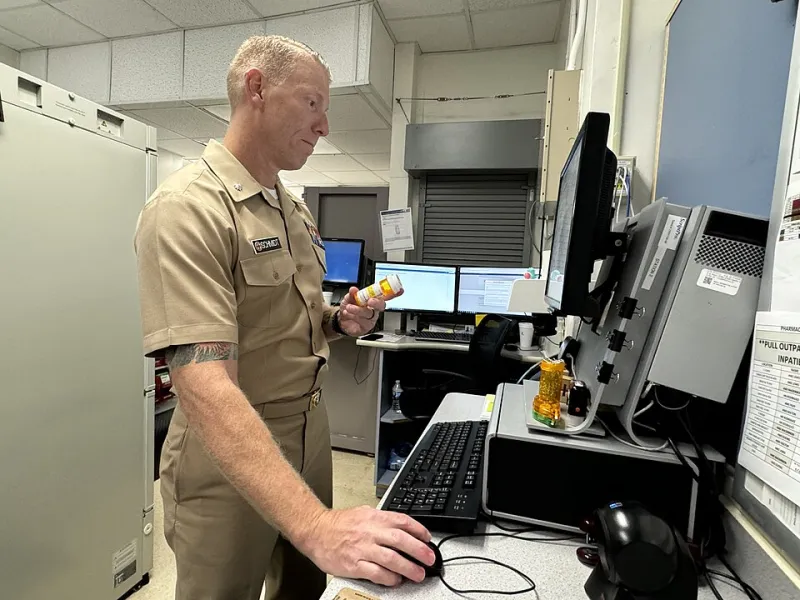
Photo: U.S. Navy NMRTC by Emily McCamy, Public domain, via Wikimedia Commons
When a pharmacist in Hamilton fills a prescription for oxycodone, something happens in the background that the patient never sees: the dispensing is transmitted to Ontario's Digital Health Drug Repository, where it joins a longitudinal record of every monitored medication that patient has received. Similar transmissions occur in British Columbia through PharmaNet, in Alberta through its TripTix and pharmaceutical data systems, and through dedicated monitoring programs in most other provinces.
Prescription monitoring programs (PMPs) are among the least understood pillars of Canadian medication safety. They also raise legitimate privacy questions. Both facts deserve honest examination.
What These Systems Actually Record
Contrary to popular assumption, provincial monitoring does not capture every prescription a Canadian fills. Scope varies by jurisdiction, but monitoring typically focuses on medications with significant potential for harm or diversion:
- Opioid analgesics (including codeine-containing products at prescription strength)
- Benzodiazepines and other sedatives
- Stimulants used for ADHD
- Certain other controlled substances under the Controlled Drugs and Substances Act
For each monitored dispensation, the record includes the drug, dose, quantity, date, prescriber, and dispensing pharmacy. Routine prescriptions — your antihypertensive, your inhaler, your statin — generally fall outside monitoring databases in most provinces, though they exist in your pharmacy's own dispensing history and, in some jurisdictions, broader medication records.
How the System Flags Danger
The clinical value of these databases became starkly apparent during Canada's opioid crisis. Consider a patient receiving opioids from two prescribers — a family physician and, say, a dentist after a procedure — who fills both prescriptions at different pharmacies. No single pharmacist would see the full picture. The provincial database would.
Pharmacists consult these systems before dispensing monitored drugs, and the records enable them to identify:
- Duplicate therapy: overlapping opioid or benzodiazepine fills that, combined, risk respiratory depression.
- Drug interactions between sedating medications dispensed at different locations.
- Early refills suggesting diversion or misuse.
- Doctor shopping patterns that signal a patient at risk of overdose.
Crucially, the system is designed as much for intervention as enforcement. Many provinces pair monitoring with naloxone distribution programs and connect flagged patients to addiction medicine resources. A pharmacist who sees a concerning pattern can initiate a conversation, contact the prescriber, and in some provinces recommend a treatment agreement — steps that have prevented overdoses.
The Privacy Question, Addressed Directly
Patients sometimes worry: who can see my record, and can it be used against me?
Access is restricted and audited. In British Columbia, for example, PharmaNet records are available to pharmacies and, with protections, to emergency departments — but access is logged, and misuse of patient data carries professional and legal consequences. Employers and insurers do not have access to provincial monitoring databases. Police access generally requires legal process. In most provinces, patients can also request their own records to verify accuracy.
There is a broader privacy consideration worth acknowledging honestly: monitoring programs exist because monitored medications carry a documented risk of fatal misuse. Canadians filled tens of millions of opioid prescriptions during the peak of the crisis. The databases are a societal response to a genuine public health emergency, built with legislative privacy safeguards — a balance, like all such balances, that remains subject to public debate and legislative revision.
What This Means for the Online Pharmacy Patient
Patients using licensed Canadian online pharmacies sometimes assume digital dispensing escapes monitoring. It does not. A properly licensed online pharmacy operating within a province reports monitored dispensations exactly as a corner pharmacy does — one of the clearest markers separating legitimate operations from rogue websites, which exist entirely outside provincial oversight.
This is worth remembering when evaluating any online pharmacy: if a website offers opioids, benzodiazepines, or stimulants without requiring a valid prescription or bypassing provincial reporting, it is not a licensed Canadian pharmacy. It is a criminal operation.
Protection, Not Surveillance
The most accurate way to understand Canada's prescription monitoring infrastructure is this: it is a safety net woven between prescribers and pharmacies who otherwise cannot see each other's work. For the overwhelming majority of patients — those taking monitored medications exactly as prescribed — the database changes nothing about their care and shields their information behind audited access rules. For the minority at risk of dangerous duplication, it may be the intervention that saves their life.
If you have questions about what appears in your provincial record, your pharmacist can explain the program in your jurisdiction and how to request your own information. Transparency about the system is, ultimately, part of its legitimacy.