Opening the Bottle Should Not Be the Hardest Part: Accessible Packaging for Canadian Patients

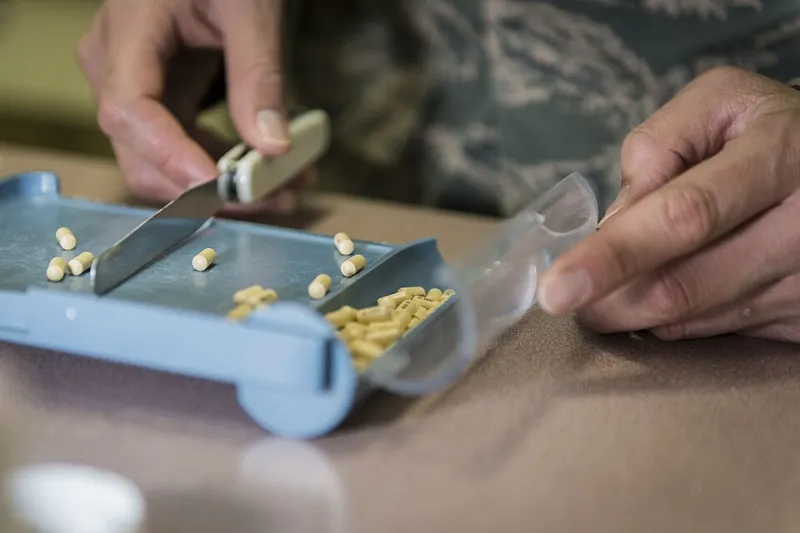
Photo: U.S. Air Force photo by 1st Lt. Sidney Walters, Public domain, via Wikimedia Commons
Margaret is eighty-one, lives alone in a small Ontario town, and takes five medications. She has never missed a dose through forgetfulness. Her difficulty is more basic: her hands. Rheumatoid arthritis has weakened her grip, and on a bad morning the child-resistant closure on her blood pressure bottle simply will not turn.
She is not unusual. Arthritis affects millions of Canadians, and age-related vision changes are close to universal after seventy. Yet prescription packaging is designed for an average adult with full grip strength, sharp near vision, and steady hands. The gap between that design and the people using it produces spilled tablets, missed doses, and, occasionally, a bottle left open on the counter for want of the strength to close it.
The good news is that most of this is solvable, and the solution usually begins with a single sentence to your pharmacist.
Why the Cap Exists, and What It Costs
Child-resistant packaging is a genuine safety measure, and its benefits are not theoretical. But it was never intended to be used by everyone in every household. Canadian rules allow a pharmacist to dispense medication in an easy-open container at the patient's request, provided the patient understands the trade-off. That trade-off is straightforward: a closure that opens easily also opens easily for a visiting grandchild.
Patients who choose this option should store medication in a locked drawer or a high cabinet, and should be mindful of children visiting the home. Where a child lives in the household full time, the conversation becomes more nuanced, and a pharmacist can suggest alternatives such as unit-dose packaging that a child cannot easily access.
Options Worth Asking About
Easy-open or reversible closures. Many caps are already two-way: flipped one way they are child-resistant, flipped the other they are not. Ask your pharmacist to show you which type your bottle has.
Compliance packaging. Weekly blister cards or pouches, prepared by the pharmacy, remove both the cap and the counting. They also make it obvious at a glance whether a dose has been taken. Some provinces charge a modest fee for this service; others cover it for certain patients. Ask before assuming a cost.
Larger, clearer labels. Labels can often be reprinted in a larger font, with higher contrast, or with simplified instructions. Some pharmacy software supports auxiliary symbols that make the dosing schedule easier to read at a glance.
Alternative containers. Wide-mouth bottles with ridged grips are easier for hands with reduced dexterity. Where tablets are large or numerous, a wider container reduces the difficulty of extraction.
Devices and aids. Pill splitters with a large handle, tablet crushers where appropriate, magnifying lenses for labels, and tube squeezers for topical products are inexpensive and widely available. Your pharmacist can advise which are suitable for your specific medications, and which are not: not every tablet may be split or crushed.
Vision Loss Deserves Its Own Conversation
For patients with low vision, the challenge is often the label rather than the lid. Confirming colours, strengths, and schedules becomes an exercise in guesswork, and guesswork is how double doses happen.
Ask whether your pharmacy can provide large-print labels, high-contrast printing, or a spoken-label or tactile option through the dispensing software. Some pharmacies offer audio labels or smartphone-linked identification. If these are not available locally, an alternative is to ask for a different shape or size of container for each medication so that bottles can be distinguished by touch.
How to Raise It Without Feeling Awkward
Many patients endure packaging difficulty silently, treating it as a personal failing rather than an access issue. It is neither. A workable script is simply: I am having trouble opening this, and I would like to discuss options.
Be specific about the barrier. Is it grip strength, a tremor, reduced vision, or difficulty manipulating small tablets? The answer shapes the recommendation. Mention any children who visit or live in the home, since that affects which closures are appropriate. Ask whether the change is a one-time adjustment or automatically recorded on your file, so you do not have to repeat the request every month.
If you use a compliance pack, ask what happens when a dose needs to be changed mid-week, and how a missed dose is handled inside the packaging.
A Word on Safety
Accessibility should never come at the cost of accuracy. If you transfer tablets into a different container at home, keep the original label with it. If you use a blister card, store it away from heat and damp, since doses sealed in plastic are still vulnerable to a humid bathroom shelf. And if dexterity has declined enough that opening a bottle is difficult, that change is worth mentioning to your physician as well, since it may reflect a broader health shift.
Small Adjustments, Real Independence
Medication only works if it can be taken. Packaging that defeats the patient is not a minor inconvenience; it is a barrier to treatment, and one that a pharmacist can often remove in a single conversation. Margaret now receives her medications in weekly blister cards, prepared by her local pharmacy, and keeps a magnifier beside the kitchen table. Her routine has not changed. Her ability to follow it has.
That is the standard worth asking for: not packaging that is easy to open in the abstract, but packaging that works for the hands and eyes that will actually open it.